Wednesday, February 25, 2015

8. Day 4 (Aug 20) - Around Frankfurt: Jewish Museum and South to Africa

We also visited the Frankfurt Jewish Museum.  If the Frankfurt City Museum was unfocused, the Frankfurt Jewish Museum had three focal points, but the focus would shift from item to item without warning. Indeed, it’s not clear whether the museum curators were aware of the focus.

The Jewish Museum is located in the same general downtown area of Frankfurt.  It is housed in a Rothschild Palais and its adjacent building which is considered an outstanding example of the residence of an upper middle class Jewish family in the 19th Century.
Jewish Museum - Frankfurt
The three areas of focus at the museum are: (1) what is Judaism; (2) what is the history and treatment of Jews in the world generally; and (3) what is the history and treatment of Jews in Germany and especially in Frankfurt.  In regard to the general treatment of Jews, Frankfurt was probably no better and no worse than many places in Europe, although there is some indication that at times Jews in Frankfurt were treated better than in many other parts of Europe.  Of course during the Nazi era, Jews in Frankfurt were treated much the same as elsewhere in Germany.  The museum makes no attempt to downplay, minimize, explain or excuse the treatment of Jews by the Nazis nor does it make any apologies for what happened.  It is simply describing what happened.  And, I believe that this is appropriate.  

A number of the exhibits show Jewish beliefs and culture.  There is much description of how Jews cared for the poor and sick in their community and how important education was.  And there is a description of Jewish practice. 

There is a model of what the Jewish Ghetto section of Frankfurt looked like, and it was explained that there was little light and air in the highly packed buildings.

Model of Frankfurt Ghetto
There were also two figures dressed in what is described as typical Jewish dress for a woman 
Jewish Female Dress
and for a man for much of this time.
Jewish Male Dress
Next to this display is a replica of the action of the Frankfurt Council in 1541 requiring that Jews wear an identifying insignia on their clothing.  (The exhibit notes that this requirement was no longer enforced by the early 18th century and in 1728 the council abolished the requirement.

Frankfurt Council Regulation Regarding Jewish Clothing
One of the exhibits in the museum showed how Jews were forced out of many countries in Europe from the 14th to 16th Century.


Where Jews Went
Where did these Jews go?  The exhibit show two significant countries that welcomed the Jews.  King Alexander Jagiellon of Poland welcomed Jews beginning in the early 16th Century, “ushering in a Jewish Golden Age in Poland lasting until the Cossack uprising in 1648.”  And in 1496 Sultan Bayed II of the Ottoman Empire offered refuge to Jews as well.  

Then we were off to the Frankfurt airport for a quick flight to Munich, followed by a much longer flight south from Munich to Johannesburg.  Thanks to frequent flyer miles, the long flight was comfortable ...
South African Airlines Business Class Seating
and we were well fed with both the main course
Dinner - Main Course
and the cheese and fruit course.
Cheese and Fruit Course
Next stop: Johannesburg

Link to full resolution photos


Monday, February 23, 2015

7. Day 3 (Aug 19) - Around Frankfurt: City Museum

(Note: In response to a sensible request, I am including the calendar date -- from 2014 -- that each day represents in the title to each posting.)

The City of Frankfurt has a city museum that can best be described as a collection of various things that don’t necessarily have to do with the city but, in some cases, were merely collected by people who lived in the city and the museum acquired the collection.  In some ways it is reminiscent of the Smithsonian Museum of American History about which the New York Times said upon the reopening of the revamped museum that it was a museum “where individual objects are so impressive, while the whole is so out of focus.”  The Frankfurt City Museum similarly lacks focus and while a few objects were fun, I wouldn’t say any were “so impressive.”  

As an example consider this crown, orb, and scepter.  
Replica Crown, Orb, and Scepter

These are not even original, but replicas of the German emperor’s insignia of office (as holder of the “Holy Roman Emperor” title).  And the out-of-focus sign in the background gives the provenance not only of the original insignia but of these copies.  Still, why here in Frankfurt and in the City of Frankfurt Museum?

What the information doesn't tell you, and you are simply expected to know, was that the election of the Holy Roman Emperor took place in Frankfurt starting in 885 until 1792.  The coronation of the Emperor took place starting in 1562 (it previously was in Aachen) again until 1792.  

Returning to the lack of focus theme, how about three suits of armor without much more explanation of them or what they are than the title?
Suits of Armor
There was also a display of about 20 metal masks from suits of armor, and several swords from a similar period.  And while these similar objects were all displayed next to each other, there still was not much explanation of what they were (shouldn’t we all know) or why they were here particularly.

And then, in the next room, was found this.  
Faience Collection
The fairly typical albeit large collection of faience is here merely because it is, as the wall sign indicates, “The Faience Collection of a Manufacturer.”  And if faience isn’t your thing, then maybe butterflies are.
Butterflies
Although the butterflies are mounted in different frames without any discussion of why each one was in a particular frame or even what kind of butterfly each one was.  

But the most interesting (to me at least) item in this museum actually had several connections to Frankfurt.  It is this gold renaissance goblet and it is an original.

Renaissance Gold Goblet
What is interesting about this item is not what it is.  Its title is: “Back in Town - a Renaissance Goblet Made in Frankfurt and Formerly in the Ullmann Collection.”  The goblet made by Hans Knorr, a master goldsmith in Frankfurt who was awarded the title in 1573 and was one of about 50 goldsmiths active in Frankfurt during that time.  But the last part of the title — Formerly in the Ullmann Collection — is expanded on in the description of the item.  We learn that the Ullmanns (Albert and Hedwig and their family) were important art collectors in Frankfurt but “Today the Ullmann Collection is scattered all over the world.  This came about because when the Nazis finally forced the Ullmanns to leave Germany, sometime after 1933, they had to pay the Reich emigration tax and similar fees which was especially onerous on property held by Jews.  Hedwig Ullmann had to sell much of her collection in order to pay the taxes and fees when leaving Germany.”  We further learn, “The small goblet was one of the few objects to remain with her and it accompanied her on the trip from Germany to Australia.”  She died in Australia in 1945.  The museum purchased the goblet in  2012, presumably from Hedwig’s heirs although we aren’t told.

And so ended our only full day in Frankfurt.  Tomorrow is a trip to the Jewish Museum and then to South Africa.


Friday, February 20, 2015

6. Day 3 - Around Frankfurt: On the Water

(Note: Some of you have noted that for a blog on Southern Africa, there seems to be a lot about Frankfurt, which is at least somewhat true.

1) It seems like a lot because you all want to see Southern Africa. 

2) I have this annoying habit of dividing each day into 2 or 3 postings.  For that I can only say, guilty.  And you will have many more posts on Southern Africa than on Frankfurt.

3) I do believe that all things are interconnected.  The support of some of the pro-Apartheid leaders in South Africa for Nazi Germany is an important part of the history of the struggle for democracy in South Africa.  And the next two postings after this one – which complete the section on Frankfurt – contain some about Nazi Germany.

4) I admit to being a completist.  These photos were all taken on the same trip.  At the end there will be material on our week in London.  This too will contain material relevant to the South Africa part of the discussion. 

5) If you really don’t want to read the posts on Frankfurt, please feel free to just delete or skip.  My feelings won’t be hurt – and I won’t know in any case.  The first post from South Africa will be posted on Feb. 28 although the post on Feb. 25 includes discussion of the trip from Frankfurt to Johannesburg via Munich (Airport).)

As I’ve noted, Frankfurt is divided geographically into north and south sections, bisected by the Main River which flows east/west.  The divide is reflected in many differences between the two parts .  North of the river is the city center, and all the new financial and other skyscrapers as well as the trade fair section.  It was the part of the city that was significantly damaged by bombing in World War II.  The south part of the city is known as Sachsenhausen which I was told means Saxon housing although I haven’t been able to confirm this  The south section has very narrow, winding streets and older houses which were not the subject of war bombing.  It also seemed more rural.

The area along both banks of the Main river are significantly green and either recreational or cultural.  Many of the museums of Frankfurt are strung along the river.  Here is one section of both sides of the river as seen from the tour boat.

Both Sides of the River
Here is a view of the north side of the river in an area with very little green along the north shore, which does have less green than the south shore.

North Side of River with Little Green
And a view of the north side with a bigger green buffer between the buildings and the river.

North Side of Rive with More Green
There is also some art work along the river that at least pays some homage to the fact that it is on a body of water.

Art Work Along River
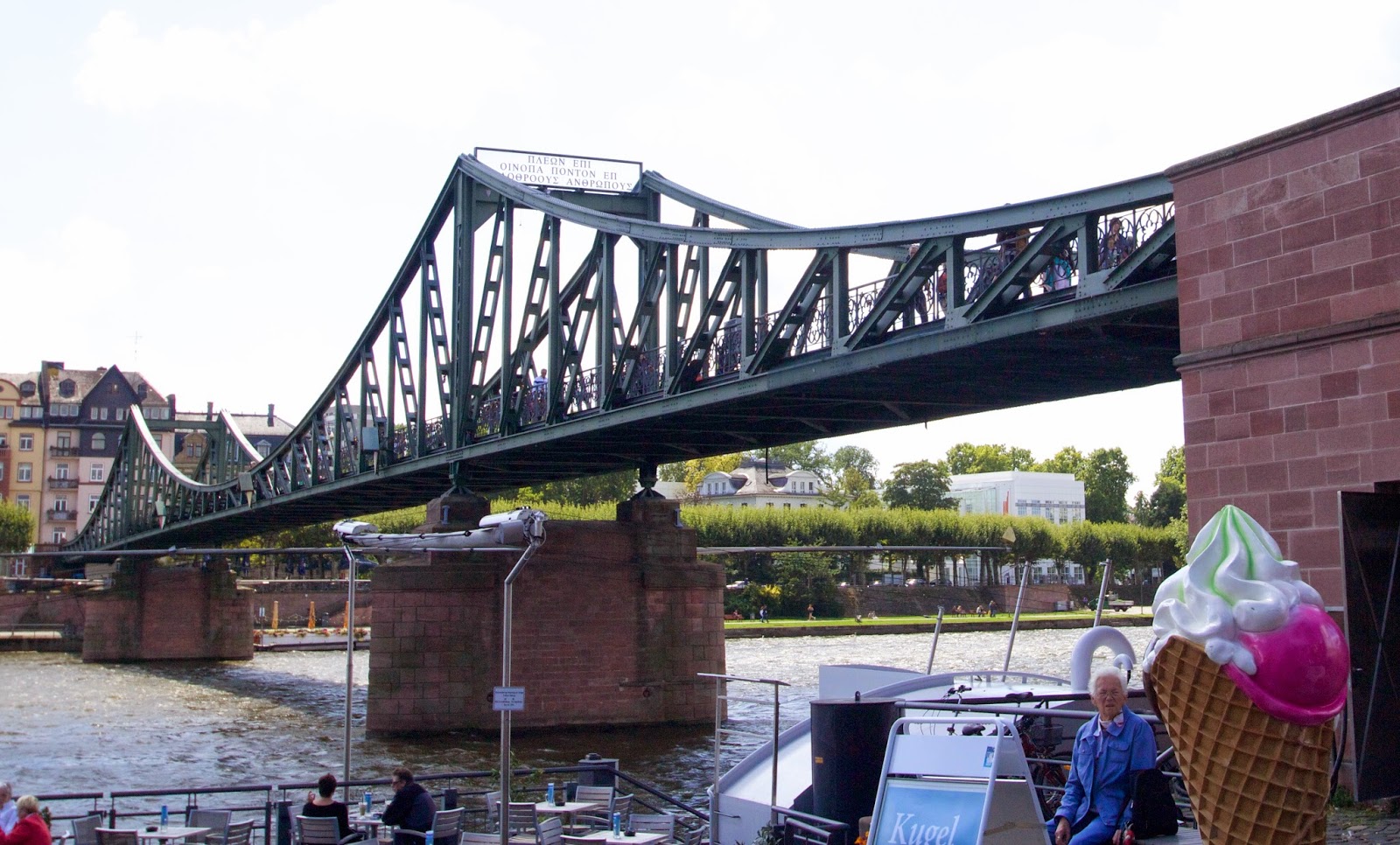
As to be expected of a river flowing through a major city, there are a number of bridge crossings.  Some are fairly old and seem of utilitarian design, although I leave to others to explain both the meaning of the apparently Greek sign on the first tower and the reason that there is a sign in Greek on a bridge in a German city.

Old Bridge with Greek Lettering
This is a somewhat less ancient bridge but the design is very interesting and extends to the piers of the bridge.

Less Ancient Bridge
And this fairly modern footbridge, vaguely reminiscent of the Jubilee Footbridge on the Thames.

Modern Footbridge
After getting off the river, we visited the Frankfurt City Museum, the subject of the next post.  It was an interesting insight into the people of the city including what happened during World War II.  Remember, I did say it’s all connected.

Link to Full Resolution Photos


Tuesday, February 17, 2015

An explanation and an apology

As I had feared, the video not only doesn't come through on the email as a video, it comes through as just a space.  So if you want to see it you have three options:

1) Click on the link called "Click on this link" below and you will be taken to the photos and videos in SmugMug.  Click on the last item which is the video and enjoy.

Click on this link

2) Go to the blog and watch the video there.  Technically the email you get is not the blog but a reminder of the new posting in the blog which also contains the full text (but not the video) of the new posting.  How this differs from the blog, except in this minor way, is not clear to me.

2) Click on the link in the previous email that says "Link to full resolution photos" below the space and you will be taken to the photos and videos in Smug Mug.  Click on the last item which is the video and enjoy.

The title in my email misspells Africa.  I am aware of this.  The only way it can be fixed is if all of you are willing to sign up again for the blog.  I hope that the error is less trouble than signing up again as I'm leaving it the way it is.  It just shows I'm not perfect (which is probably not shocking to any of you).

We now return you to the travel blog in progress (or at least will on Feb. 19).

Monday, February 16, 2015

5. Day 3 - Around Frankfurt: New Buildings

As I noted, Frankfurt is a commercial and financial center, and many of the very modern structures are built by and for those companies. One of the nicknames for Frankfurt, taking into account both the many tall modern buildings and the Main River than runs through the center is “Main-Hattan."

It is also the headquarters for the European Central Bank whose new headquarters is being built here.  The emblem of the bank on that sign doesn’t correlate with the official emblem shown on their website although in both cases they show 12 stars, considerably less than the number of countries in the Eurozone.  I have no explanation.

European Central Bank
Near our hotel was a shopping center (Skyline Plaza) where there was an unusual use of various colors, always on just one side of the metal columns on the exterior of the buildings.  

Skyline Plaza - Yellow to Red

Skyline Plaza - Red

Skyline Plaza - Green
This building should be the headquarters of an Apfelwein producer and, while that is not the case, it is known colloquially as the Apfelwein building.

"Apfelwein" Building
And in a wonderful example of form over function, as well as the doctrine of unintended consequences, is this building:

Half-Crown Building
After this building was built it was discovered that ice collected on the crown in winter and pieces would melt off and create a potentially dangerous situation.  So, they provided heat to the crown which meant that ice wouldn’t form on it.  Problem solved.  Except that birds discovered the wonderful heat in the crown and wouldn’t fly south for the winter since it was warm there.  We never did learn how that problem was solved — if it was.


Our hotel is in the Frankfurt Messe (Frankfurt trade fair) area.  Here is a large (21 meters tall if Wikipedia is to be believed) kinetic sculpture called the Hammering Man.  It is one of 11 such sculptures throughout the world, second in height among them (the one in Seoul is 22 meters).  The artist, Jonathan Borofsky, says, “At its heart, society reveres the worker.  The Hammering Man is the worker in all of us.”  This is a 15 second video of the Hammering Man in action.


(Technical note: I don't know if those of you getting the blog via email are able to see the video in action but, if not, then just go to the blog itself where you can see it.)