Sunday, February 15, 2015

4. Day 3 - Around Frankfurt: Food

(Apology, or to use the probably out-of-date vernacular, my bad.  I had meant to post this on Friday.  Somehow Friday and Saturday both got away from me -- retirement is not easy <g>.)

Now, before going onto the hodgepodge of new architecture in Frankfurt, as befitting a commercial and financial center, let’s take a break (figuratively) for lunch (which we did literally).  As I’ve noted, there are several restaurants in the town square.  And this being Germany, pork and sauerkraut were definitely on the menu.

Pork and Sauerkraut
But note the glass in the upper right corner.  It’s not beer, nor is it really wine.  Want a closer look?

Apfelwein
It’s Apfelwein and is a form of apple cider made in the German state of Hesse, where it is the state beverage.  (Frankfurt is the capital of Hesse.)  As the name suggests, it is made from fermented apples, but then bags of astringent berries called service tree berries are added to make the drink more like a wine than a traditional cider.  The glass shown in the photo is the traditional glass for Applewein, the cuts in the glass refracting light into the Applewein and, in older times when cutlery was rarely used at meals, improving the grip of the glass.

Before we went to the restaurant where we did eat, we checked out what appears to be a city run cafeteria also on the town square.  The cafeteria is inside a magnificent (probably reconstructed) building that is part of the various city structures.

City Cafeteria Inside
The steam tables with the food are out of the picture, up the stairs in the rear and to your right.  And I couldn’t resist a photo of a man who must have been paid by the tourist office to eat his lunch here.

Man in Cafeteria

Tuesday, February 10, 2015

3. Day 3 - Around Frankfurt: Old Buildings

The next morning begins the full day in Frankfurt am Main (on the Main river — pronounced “mine”) designed to recoup from the trip and to try to adjust our internal clocks.  And what better way than to play tourist.  

Frankfurt architecture is an interesting collection of very old-looking buildings and quite modern buildings.  Let’s start by looking at some of the old-looking buildings.
Römer
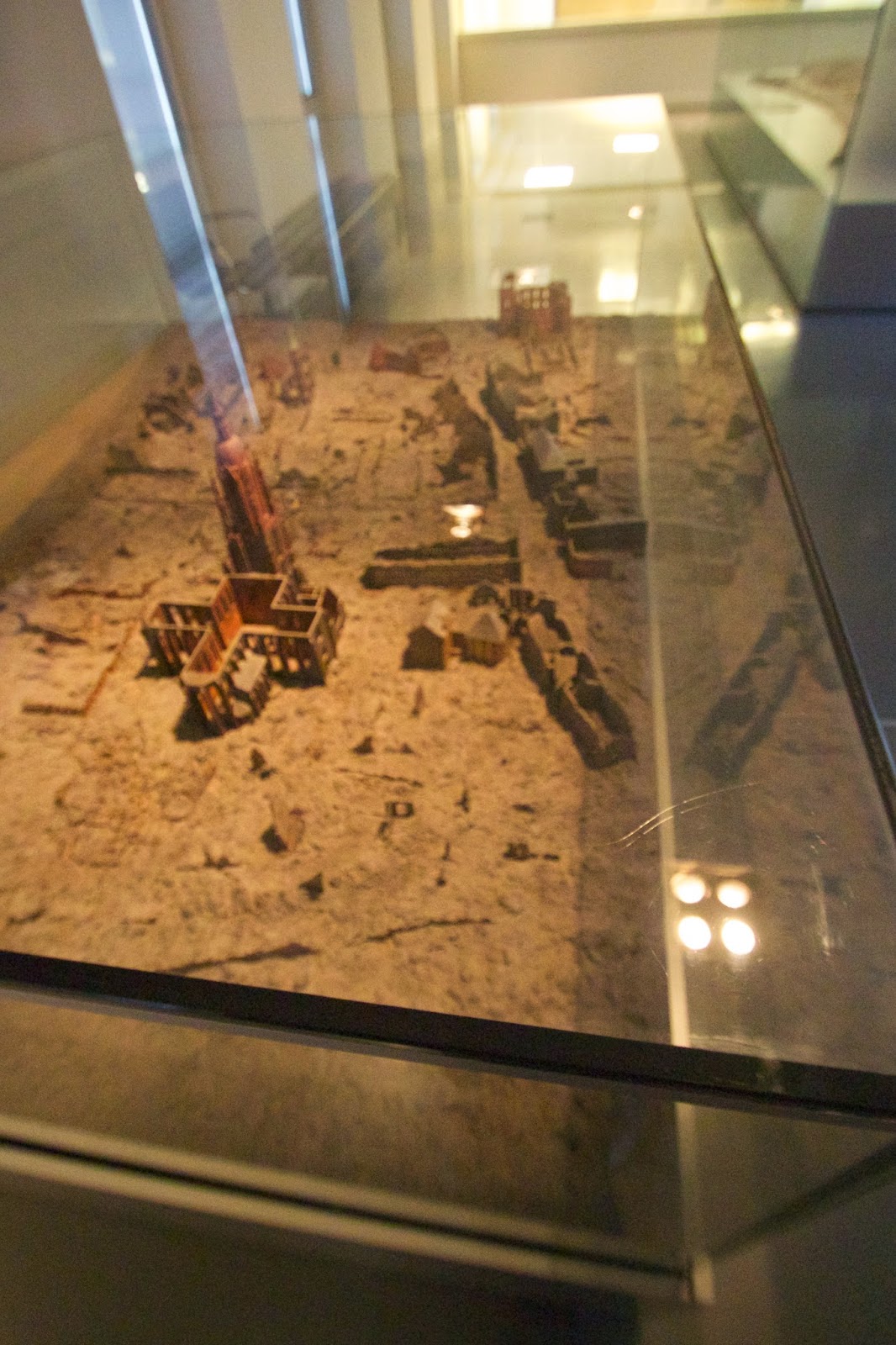
This three-part building is the oldest section of the town hall or Römer of Frankfurt.  It was originally constructed in the 15th-18th centuries.  It is on a large square with some restaurants directly opposite.  The building in the center is known as Zum Römer and means “at the Roman.”  The name refers to the Roman settlements that predated the founding of Frankfurt.    Now, before you get too impressed with how well these structures have aged, you need to know that during the Second World War the entire central (i.e., old) section of Frankfurt was heavily damaged and what you see here is the renovated and partially reconstructed building.  Exactly how much was destroyed, and therefore how much reconstruction was needed, was exaggerated in the immediate post-war era to ensure more resources for reconstruction.  This exhibit, now in the Frankfurt City Museum, was designed to show how utterly devastated the city was.  


Exaggerated Destruction
The reality, as shown in this photo which is on display at the exterior of the city museum, is somewhat less than the near totality although it is still significant.

Actual Destruction
The explanation in the city museum is that these documents show “the struggle between historical reconstruction and modernization after 1945.  The model was obviously used as a ‘supporting argument’ in an urban development competition held in 1946.  The degree of destruction was depicted as more severe that it actually was in an effort to gain support for an absolute new beginning."

The town hall has been expanded several times and in the late 19th century a wing was built across the street.  This covered stone bridge was built to connect that wing to the main building.  It was called in German Seufzerbrücke which translates to the Bridge of Sighs and was apparently so named because the new wing was where Frankfurt citizens went to pay their taxes.  The only connection to the same-named bridge in Venice seems to be the name, and the irony of comparing paying taxes to being imprisoned in the Doge’s prison was lost.  Of course the Venetian bridge was only named that long after it ceased to be used for that function.


Bridge of Sighs


I know nothing about this building just opposite from the city museum but I sure love the mashup of architectural styles (and periods).  


Mashup of Architecture
Next on the tour -- lunch, of course.

Link to full resolution photos

A note of thanks: My good friend Jasmin Patel Levander spotted a couple of typos in the first posting.  She graciously offered to copy edit my posts, rather than just complaining about typos.  Good friends are a blessing.  Good friends who provide copy editing services are even better.

Saturday, February 7, 2015

2. Part I - Getting here / Day 1-2 - To Frankfurt

The trip to South Africa was a bit circuitous, in large part to enable us to get there in a reasonably rested state.  It isn't good to start what is supposed to be a fun vacation jet-lagged and stiff and sore from a long plane ride.  The shortest length of flights generally available from SF to Johannesburg take over 24 hours including a reasonable layover or 3 hours at some airport because no one flies non-stop.

So, instead, we decided on a flight to central Europe (in the same time zone as South Africa -- at least at this time of year) and several days layover there to get rid of jet-lag.  Then a nice long overnight flight in business class (thank you credit card miles) to arrive in Johannesburg fairly well rested.  The choice of the city in Europe was based mostly on what flights to South Africa are available from there.


Going from San Francisco to Frankfurt via a change of planes in Dublin starts off with a nice BART ride to SFO.
Michael on BART
Take a farewell look at that suitcase.  You won’t see it after we leave Johannesburg for Victoria Falls.  And the yellow strap gives up the ghost shortly before then.  The guy and his iPad do make it through just fine, though.  


Then just 10+ hours later, we’re at Dublin Airport.  Being an expert in all things Irish due to 5 hours in the Dublin airport, I can say that Ireland is clearly a bilingual country although while there we heard  only English.  But Irish sure looks interesting.
Dublin Airport
Then just 2+ hours more and we’re in Frankfurt in its large airport with a lot of glass.  Frankfurt is the busiest airport in Germany and the third busiest in Europe after London Heathrow and Paris de Gaulle.  Frankfurt itself is only the fifth largest city in Germany but as a financial capital (and as a Lufthansa and United Airlines hub) draws a lot of airport traffic.
Frankfurt Airport
Now we’ve gone pretty far east (although Johannesburg is a bit further east and way further south) and it’s time for a couple of days in Frankfurt to recuperate before heading south.


We arrive in Frankfurt around 8 pm of the day after we left San Francisco at 5 pm (and due to the miracles of time zones, we have been traveling for about 18 hours).  We need rest.

Wednesday, February 4, 2015

Introduction

Into and Then Out of Africa (with apologies to Isak Dinesen).

1.  Introduction

(In August and September of 2014, Irene and I took a trip to Southern Africa — specifically South Africa, Zimbabwe, and Botswana, followed by a week in London.  This is the first of many emails / blog posts that discuss that trip and illustrate with photos — mostly taken by me.  Instructions to subscribing to these emails are in final paragraphs after the heading Instructions)

According to the interwebs, the longest distance anyone can be from any other place on the planet — the antipode of that place — is approximately 12,450 miles.  And the furtherest away we would be on this trip was about 10,630 miles in Port Elizabeth in the Eastern Cape Province of South Africa.  So while not quite the antipode of San Francisco (which is somewhere in the Indian Ocean off the east coast of South Africa), it still is hella miles from home (to use the slang that Wikipedia attributes to originating in the Bay Area).  You can see the antipode on this map in the bottom right corner.  Port Elizabeth is on the left side of the map, not quite half way up from the bottom.

San Francisco Antipode
I've promised highlights of this trip to many of you.  This will not be a full description of this trip nor always a chronological version.  The trip was wonderful and unexpected.  The unknown they (as much as I have been able to figure out) say that travel broadens the mind.  Two quotes best illustrate this to me: “Travel is fatal to prejudice, bigotry, and narrow-mindedness,” said Mark Twain.  And Samuel Johnson said, "The use of traveling is to regulate imagination by reality, and instead of thinking how things may be, to see them as they are."

These highlights will vary from post to post.  Sometimes you will get what happened on a day or, more often, the part of a day.  Sometimes you will get what I remember from several different and often disparate days and, fair warning, I may include teasers of future posts or references to prior ones.  Sometimes you will get ideas that are only vaguely related to days.  Some of these thoughts will be mine.  Some will have benefited from discussion with Irene.  Some has been enriched by what’s found elsewhere.  All will be accompanied by photos — usually 5 to 10 in each post. 

The plan is to have one post every three days.  A few items are ready to go and I will mete these out using that schedule.  Of course, if I get distracted (not that that ever happens), there could be an interval of more than three days but I’m hoping to keep it to that.  Some of the photos will be videos.  And don’t worry — you won’t be getting all or even a large number of the (over 6,000) pictures I took.  If you want more when this is done, ask and I’ll give you access to the entire set of edited photos stored online.

I know some of you have been expecting these photos for some time.  I can only say that it has taken this long to assimilate the entire experience into some form that I felt I could share it with you.  And, yes, there will be wild animals — but not exclusively or even predominately.  Southern Africa is much more than that.  Do you now that South Africa's Cradle of Humankind and the University of Witwatersrand's Origins Centre are two landmarks in terms of the origins of humankind.  We did all come from Africa.  Twain and Johnson are right.

Link to full resolution photos


Instructions

(Now, a brief discussion of logistics.  I've mentioned a blog a few times in this email/post.  A blog is geek-speak for weblog which itself is pretty geeky sounding.  In the pre-computer days we called them journals.  They are a way for a person to post information on the internet and share it with others.  I'm using a blog as a combination photo-album and slide show with written rather than oral commentary.  Each entry is called a post.  So, where do you find this blog?   Either click on this link:

http://bichael-africa.blogspot.com 

or paste the above into your browser.  You'll be taken to the first post of the blog which is the same as this email.  

(If you want to just check back here every three days or so and read what is newly posted, go for it.  You need to do nothing more.  But if you want to be notified about a new post by email, then go to the upper right corner of the webpage, just below the brown-red heading, where it says, "Receive Blog Postings by Email."  There is a place for you to enter your email address and then click on the button marked "Submit"  That's all you have to do.  And you will then receive an email containing each entry as it is posted by me, and you can either read it in your email or in the blog post itself.  

(If you tire of getting these emails, there is a link near the bottom where you can click to stop them coming.  And I won't use your email address for any nefarious purposes -- besides I already have it if you received this email.  If you want to share this blog with others, you can give them the link shown above and they can sign up too.  And if all this is too much for you -- and while I have tried to make my directions clear I may have failed -- then ask me for help.

(Now a note that many of you may wish to skip -- it's about the size, resolution, and clarity of the photographs.  The blog requires that I post pictures of a static size and while I have tried to choose a fairly large size, there may be times when a few of you might want to blow up these pictures even bigger. Or you may suffer from age-related vision degradation -- I know it well.  I've included in each post, a link to the actual photos used, as posted on my SmugMug account.  There you can view the photos in full resolution and even download them to your computer -- it's the little symbol under each photo clear to the right that looks like a downward pointing arrow with a horizontal line underneath it.  Please use that to download photos and ignore the "Buy Photos" as I don't sell my photos.  In fact, if you take leave of your senses and actually want to use one of the photos feel free to do so.  Just let people know it's my photo and if you're going to make money off of it, then let's talk.

(Now a note that all but the most geeky of your will want to skip.  Why don't I just sent you emails of each posting?  I wish I could but the simple matter is that mass emailings tend to fool some of your email programs into thinking I'm spamming you.  Hence the use of the blog workaround.  And I'm pretty certain that at least three of you receiving this email will tell me another way I could have gotten around this.  Oh well, I'll use that for the next set of photos after I return from a trip to Tibet, Nepal, and Bhutan later this year.)